








Prince George of Denmark and Norway, Duke of Cumberland (Danish: Jørgen; 2 April 1653 – 28 October 1708), was the husband of Anne, Queen of Great Britain. He was the consort of the British monarch from Anne’s accession on 8 March 1702 until his death in 1708.
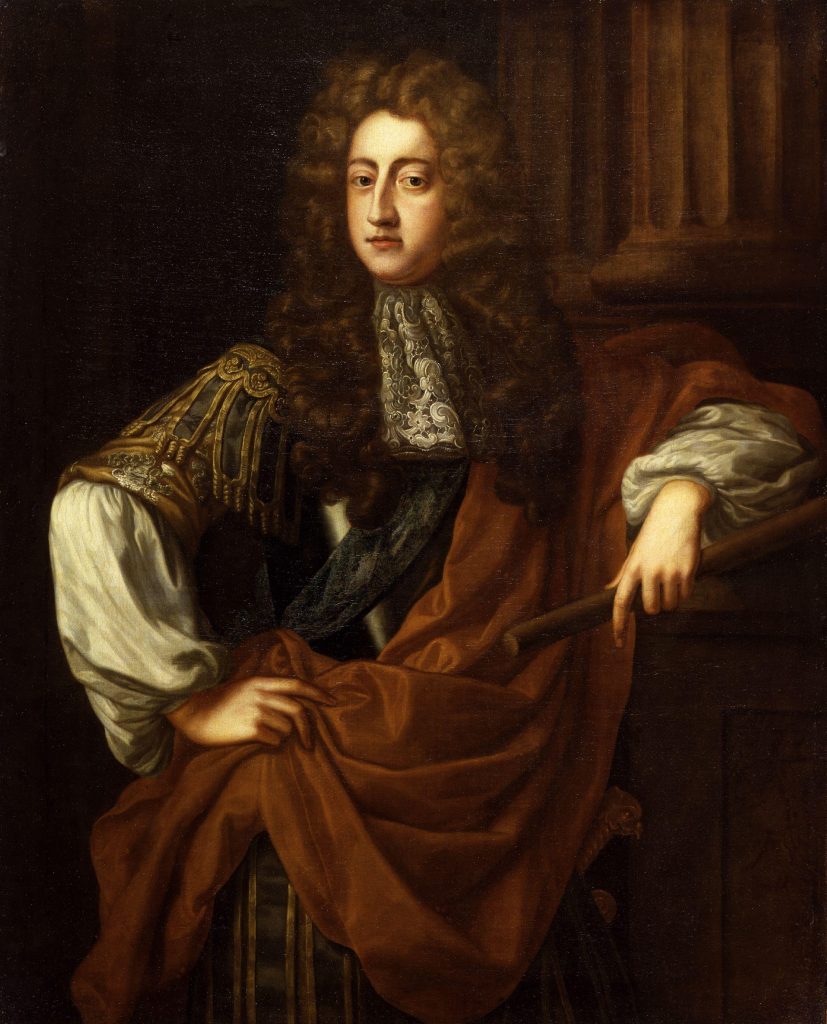
Portrait by John Riley, c. 1687
The marriage of George and Anne was arranged in the early 1680s with a view to developing an Anglo-Danish alliance to contain Dutch maritime power. As a result, George was disliked by his Dutch brother-in-law, William III, Prince of Orange, who was married to Anne’s elder sister, Mary. Anne and Mary’s father, the British ruler James II and VII, was deposed in the Glorious Revolution in 1688, and William and Mary succeeded him as joint monarchs with Anne as heir presumptive. The new monarchs granted George the title of Duke of Cumberland.
William excluded George from active military service, and neither George nor Anne wielded any great influence until after the deaths of Mary and then William, at which point Anne became queen. During his wife’s reign, George occasionally used his influence in support of his wife, even when privately disagreeing with her views. He had an easy-going manner and little interest in politics; his appointment as Lord High Admiral of England in 1702 was largely honorary.
Anne’s seventeen pregnancies by George resulted in twelve miscarriages or stillbirths, four infant deaths, and a chronically ill son, Prince William, Duke of Gloucester, who died at the age of eleven. Despite the deaths of their children, George and Anne’s marriage was a strong one. George died aged 55 from a recurring and chronic lung disease, much to the devastation of his wife, and he was buried in Westminster Abbey.
Early life
George was born on 2 April 1653 at Copenhagen Castle, the younger son of Frederick III, King of Denmark and of Norway, and Sophie Amalie of Brunswick-Lüneburg. His mother was the sister of Ernest Augustus, Duke of Brunswick-Lüneburg, later Elector of Hanover. From 1661, his governor was Otto Grote, later Hanoverian minister to Denmark. Grote was “more courtier and statesman than educator” and when he left for the Hanoverian court in 1665, he was replaced by the more effective Christen Lodberg. George received military training, and undertook a Grand Tour of Europe, spending eight months in 1668–1669 in France and mid-1669 in England. His father died in 1670, while George was in Italy, and George’s elder brother, Christian V, inherited the Danish throne. George returned home through Germany. He travelled through Germany again in 1672–1673, to visit two of his sisters, Anna Sophia and Wilhelmine Ernestine, who were married to the electoral princes of Saxony and the Palatinate.
In 1674, George was a candidate for the Polish elective throne, for which he was backed by King Louis XIV of France. George’s staunch Lutheranism was a barrier to election in Roman Catholic Poland, and John Sobieski was chosen instead. In 1677, George served with distinction with his elder brother Christian in the Scanian War against Sweden.
As a Protestant, George was considered a suitable partner for the niece of King Charles II of England, Lady Anne. They were distantly related (second cousins once removed; they were both descended from King Frederick II of Denmark), and had never met. George was hosted by Charles II in London in 1669, but Anne was in France at the time. Both Denmark and Britain were Protestant, and Louis XIV was keen on an Anglo-Danish alliance to contain the power of the Dutch Republic. Anne’s uncle Laurence Hyde, 1st Earl of Rochester, and the English Secretary of State for the Northern Department, Robert Spencer, 2nd Earl of Sunderland, negotiated a marriage treaty with the Danes in secret, to prevent the plans leaking to the Dutch. Anne’s father, James, Duke of York, welcomed the marriage because it diminished the influence of his other son-in-law, William III of Orange, who was naturally unhappy with the match.
Marriage
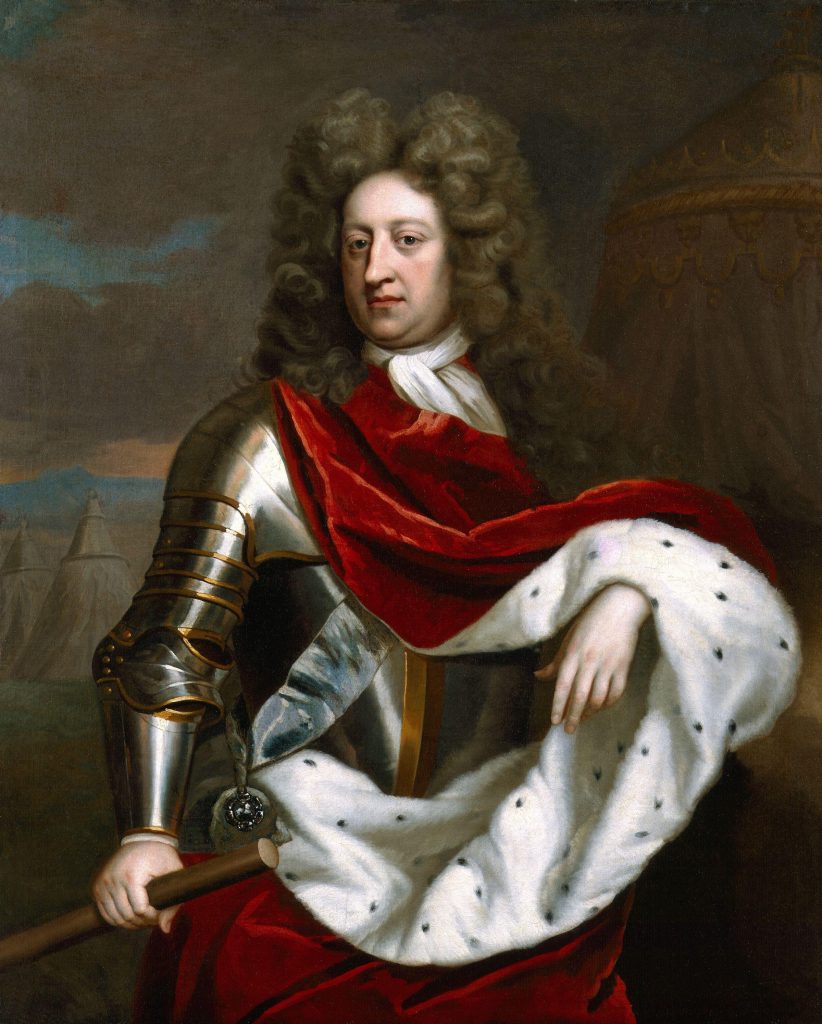
George and Anne were married on 28 July 1683 in the Chapel Royal at St James’s Palace, London, by Henry Compton, the Bishop of London. The guests included King Charles II, Queen Catherine, and the Duke and Duchess of York. Anne was voted a parliamentary allowance of £20,000 a year, while George received £10,000 a year from his Danish estates, although payments from Denmark were often late or incomplete. King Charles gave them a set of buildings in the Palace of Whitehall known as the Cockpit (near the site of what is now Downing Street in Westminster) as their London residence.
George was not ambitious, and hoped to live a quiet life of domesticity with his wife. He wrote to a friend:
We talk here of going to tea, of going to Winchester, and everything else except sitting still all summer, which was the height of my ambition. God send me a quiet life somewhere, for I shall not be long able to bear this perpetual motion.
Within months of the marriage, Anne was pregnant but the baby, a girl, was stillborn in May. Anne recovered at the spa town of Tunbridge Wells and over the next two years, she gave birth to two daughters in quick succession, Mary and Anne Sophia. In early 1687, within a matter of days, George and his two young daughters caught smallpox, and Anne suffered another miscarriage. George recovered, but both his daughters died. Lady Rachel Russell wrote that George and Anne had “taken [the deaths] very heavily. The first relief of that sorrow proceeded from the threatening of a greater, the Prince being so ill of a fever. I never heard any relation more moving than that of seeing them together. Sometimes they wept, sometimes they mourned in words; then sat silent, hand in hand; he sick in bed, and she the carefullest nurse to him that can be imagined.”He returned to Denmark for a two-month visit in mid-1687, while Anne remained in England. Later that year, after his return, Anne gave birth to another dead child, this time a son.
In February 1685, King Charles II died without legitimate issue, and George’s father-in-law, the Roman Catholic Duke of York, became king as James II in England and Ireland and James VII in Scotland. George was appointed to the Privy Council and invited to attend Cabinet meetings, although he had no power to alter or affect decisions. William of Orange refused to attend James’s coronation largely because George would take precedence over him. Although they were both sons-in-law of King James, George was also the son and brother of a king and so outranked William, who was an elected stadtholder of a republic.
Anne’s older sister Mary had moved to the Netherlands after her marriage to William of Orange. Protestant opposition to James was therefore increasingly focused around Anne and George instead of Mary, who was heir presumptive. The social and political grouping centred on George and Anne was known as the “Cockpit Circle” after their London residence. On 5 November 1688, William invaded England in an action, known as the “Glorious Revolution”, which ultimately deposed King James. George was forewarned by the Danish envoy in London, Frederick Gersdorff, that William was assembling an invasion fleet. George informed Gersdorff that James’s army was disaffected, and as a result he would refuse any command under James, but only serve as an uncommissioned volunteer. Gersdorff’s alternative plan to evacuate George and Anne to Denmark was rejected by George. George accompanied the King’s troops to Salisbury in mid-November, but other nobles and their soldiers soon deserted James for William. At each defection, George apparently exclaimed, “Est-il possible?” (Is it possible?).He abandoned James on 24 November, and sided with William. “So ‘Est-il possible’ is gone too”, James supposedly remarked.In his memoirs, James dismissed George’s defection as trivial, saying the loss of one good trooper was of more consequence, but Gersdorff claimed the defection greatly perturbed the King. The defection of George and other nobles was instrumental in whittling away the King’s support. In December, James fled to France, and early the following year William and Mary were declared joint monarchs, with Anne as heir presumptive.
Please share me.

Discover more from WILLIAMS WRITINGS.
Subscribe to get the latest posts sent to your email.




George occasionally used his influence in support of his wife, even when privately disagreeing with her views.
Interesting.
A friend rang me yesterday to talk through an issue that landed him in the dog house. He needed to step up like George.
Two rules for a happy marriage
TRIGGER WARNING – OLD FASHIONED HUMOUR
1. The wife is always right
2. If you forget the rules, ask your wife.
yes indeed david, even then they knew not to argue with the wife lol. thank you.
The loss of so many children would have been difficult for anyone to handle.
yes it is very sad bev… thanks.