



The Battle of Kilsyth, fought on 15 August 1645 near Kilsyth, was an engagement of the Wars of the Three Kingdoms. The largest battle of the conflict in Scotland, it resulted in victory for the Royalist general Montrose over the forces of the Covenanter-dominated Scottish Parliament, and marked the end of General William Baillie’s pursuit of the Royalists.
The Royalist troops were clearly visible, undisturbed by the arrival of the main army of their enemies. Having a healthy respect for his opposition, and appreciating that his own forces had already marched several miles in full kit, Baillie decided to take positions where he was and wait for Lanark’s force to appear. If Lanark arrived on the field, Baillie would have Montrose trapped between his force and the reinforcements; and if Montrose decided to attack Lanark as he arrived, Baillie could advance against the Royalist army from the rear. A direct attack by Montrose against the Covenanter line would face daunting high ground held by a numerically superior opponent.
Although Baillie’s decision was sound, he was not allowed to adhere to it. His orders were subject to the approval of the “Committee of Estates”, consisting of the Earls of Argyll, Crawford and Tullibardine, and the Lords Elcho, and Balfour of Burleigh, together with a number of Calvinist clergymen. Worried by the possibility of Montrose escaping to fight another day, they ordered a flank march around the Royalist position. Baillie protested against the redeployment, but was overruled.
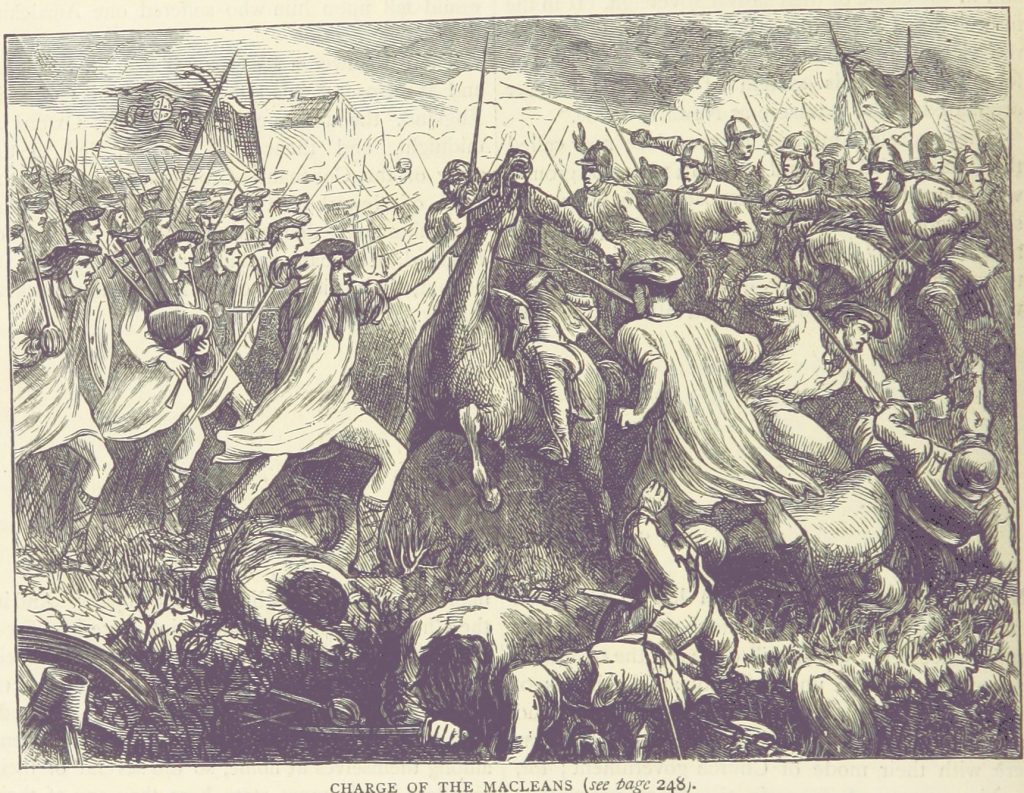
Clashes soon broke out as the Covenanter army made their flank march, with the left wing of Baillie’s force (now the rear of the flanking column) attacking the MacLean infantry occupying cottages on Montrose’s left flank, and the cavalry on the Covenanter right flank (or van) attacking the Royalist cavalry. Other Covenanter and Royalist units joined the fray, acting without orders. Montrose seized the unexpected opportunity, and sent his cavalry and Highlanders against the now disrupted Covenanter column. The mass of the Royalist infantry subsequently joined in the attack. Baillie’s army soon broke and ran in the face of the ferocious “Highland Charge”.
The Charge of Clan Maclean
Approximately three-quarters of the Covenanter troops perished. Baillie himself fled south with an escort of cavalry, but was caught in the notorious Dullatur Bog, a marshy area lying between the head waters of the Kelvin and the Bonny. He managed to escape, although he left most of his escort behind, and reached safety at Stirling Castle. During construction of the Forth and Clyde Canal, the bodies of several troopers, one still seated on a horse, were recovered from the bog.
Please share me.

Discover more from WILLIAMS WRITINGS.
Subscribe to get the latest posts sent to your email.