




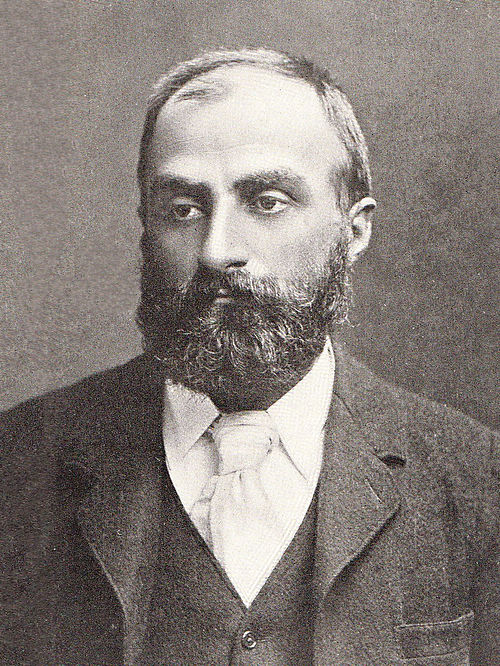
William Speirs Bruce FRSE (1 August 1867 – 28 October 1921) was a British naturalist, polar scientist and oceanographer who organised and led the Scottish National Antarctic Expedition (SNAE, 1902–04) to the South Orkney Islands and the Weddell Sea. Among other achievements, the expedition established the first permanent weather station in Antarctica. Bruce later founded the Scottish Oceanographical Laboratory in Edinburgh, but his plans for a transcontinental Antarctic march via the South Pole were abandoned because of lack of public and financial support.
In 1892 Bruce gave up his medical studies at the University of Edinburgh and joined the Dundee Whaling Expedition to Antarctica as a scientific assistant. This was followed by Arctic voyages to Novaya Zemlya, Spitsbergen and Franz Josef Land. In 1899 Bruce, by then Britain’s most experienced polar scientist, applied for a post on Robert Falcon Scott’s Discovery Expedition, but delays over this appointment and clashes with Royal Geographical Society (RGS) president Sir Clements Markham led him instead to organise his own expedition, and earned him the permanent enmity of the geographical establishment in London. Although Bruce received various awards for his polar work, including an honorary doctorate from the University of Aberdeen, neither he nor any of his SNAE colleagues were recommended by the RGS for the prestigious Polar Medal.
Between 1907 and 1920 Bruce made many journeys to the Arctic regions, both for scientific and for commercial purposes. His failure to mount any major exploration ventures after the SNAE is usually attributed to his lack of public relations skills, powerful enemies, and his Scottish nationalism. By 1919 his health was failing, and he experienced several spells in the hospital before his death in 1921, after which he was almost totally forgotten. In recent years, following the centenary of the Scottish Expedition, efforts have been made to give fuller recognition to his role in the history of scientific polar exploration.
Early life
Home and school
William Speirs Bruce was born at 43 Kensington Gardens Square in London, the fourth child of Samuel Noble Bruce, a Scottish physician, and his Welsh wife Mary, née Lloyd. His middle name came from another branch of the family; its unusual spelling, as distinct from the more common “Spiers”, tended to cause problems for reporters, reviewers and biographers. William passed his early childhood in the family’s London home at 18 Royal Crescent, Holland Park, under the tutelage of his grandfather, the Revd William Bruce. There were regular visits to nearby Kensington Gardens, and sometimes to the Natural History Museum; according to Samuel Bruce these outings first ignited young William’s interest in life and nature.
In 1879, at the age of 12, William was sent to a progressive boarding school, Norfolk County School (later Watts Naval School) in the village of North Elmham, Norfolk. He remained there until 1885, and then spent two further years at University College School, Hampstead, preparing for the matriculation examination that would admit him to the medical school at University College London (UCL). He succeeded at his third attempt, and was ready to start his medical studies in the autumn of 1887.
Please share me.

Discover more from WILLIAMS WRITINGS.
Subscribe to get the latest posts sent to your email.