








Glastonbury (/ˈɡlæstənbəri/ GLAST-ən-bər-ee, UK also /ˈɡlɑːst-/ GLAHST-)[3][4] is a town and civil parish in Somerset, England, situated at a dry point on the low-lying Somerset Levels, 23 miles (37 km) south of Bristol. The town had a population of 8,932 in the 2011 census. The town is less than 1 mile (2 km) across the River Brue from Street, a village which is now larger than Glastonbury.
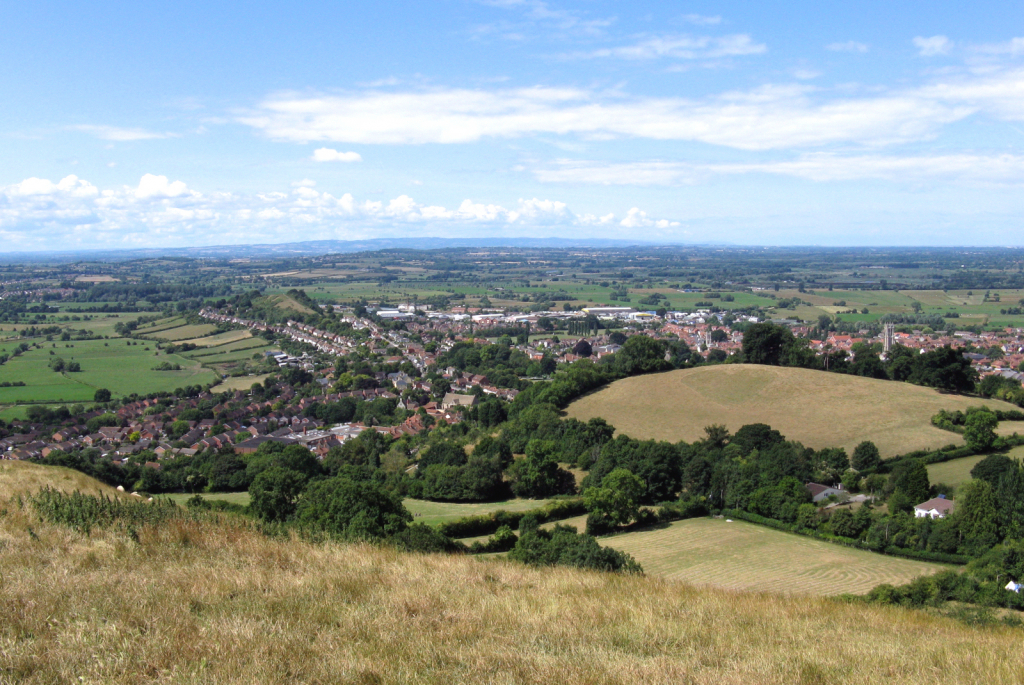
Evidence from timber trackways such as the Sweet Track show that the town has been inhabited since Neolithic times. Glastonbury Lake Village was an Iron Age village, close to the old course of the River Brue and Sharpham Park approximately 2 miles (3 km) west of Glastonbury, that dates back to the Bronze Age. Centwine was the first Saxon patron of Glastonbury Abbey, which dominated the town for the next 700 years. One of the most important abbeys in England, it was the site of Edmund Ironside’s coronation as King of England in 1016.[citation needed] Many of the oldest surviving buildings in the town, including the Tribunal, George Hotel and Pilgrims’ Inn and the Somerset Rural Life Museum, which is based at the site of a 14th-century abbey manor barn, often referred to as a tithe barn, are associated with the abbey. The Church of St John the Baptist dates from the 15th century.
The town became a centre for commerce, which led to the construction of the market cross, Glastonbury Canal and the Glastonbury and Street railway station, the largest station on the original Somerset and Dorset Railway. The Brue Valley Living Landscape is a conservation project managed by the Somerset Wildlife Trust and nearby is the Ham Wall National Nature Reserve.
Glastonbury has been described as having a New Age community, and possibly being where New Age beliefs originated at the turn of the twentieth century. It is notable for myths and legends often related to Glastonbury Tor, concerning Joseph of Arimathea, the Holy Grail and King Arthur. Joseph is said to have arrived in Glastonbury and stuck his staff into the ground, when it flowered miraculously into the Glastonbury Thorn. The presence of a landscape zodiac around the town has been suggested but no evidence has been discovered. The Glastonbury Festival, held in the nearby village of Pilton, takes its name from the town.
History
Prehistory
During the 7th millennium BC the sea level rose and flooded the valleys and low-lying ground surrounding Glastonbury so the Mesolithic people occupied seasonal camps on the higher ground, indicated by scatters of flints. The Neolithic people continued to exploit the reedswamps for their natural resources and started to construct wooden trackways. These included the Sweet Track, west of Glastonbury, which is one of the oldest engineered roads known and was the oldest timber trackway discovered in Northern Europe, until the 2009 discovery of a 6,000-year-old trackway in Belmarsh Prison. Tree-ring dating (dendrochronology) of the timbers has enabled very precise dating of the track, showing it was built in 3807 or 3806 BC.[10] It has been claimed to be the oldest road in the world. The track was discovered in the course of peat digging in 1970, and is named after its discoverer, Ray Sweet. It extended across the marsh between what was then an island at Westhay, and a ridge of high ground at Shapwick, a distance close to 2,000 metres (1.2 mi). The track is one of a network of tracks that once crossed the Somerset Levels. Built in the 39th century BC, during the Neolithic period, the track consisted of crossed poles of ash, oak and lime (Tilia) which were driven into the waterlogged soil to support a walkway that mainly consisted of oak planks laid end-to-end. Since the discovery of the Sweet Track, it has been determined that it was built along the route of an even earlier track, the Post Track, dating from 3838 BC, and so 30 years older.
Glastonbury Lake Village was an Iron Age village, close to the old course of the River Brue, on the Somerset Levels near Godney, some 3 miles (5 km) north west of Glastonbury. It covers an area of 400 feet (120 m) north to south by 300 feet (90 m) east to west, and housed around 100 people in five to seven groups of houses, each for an extended family, with sheds and barns, made of hazel and willow covered with reeds, and surrounded either permanently or at certain times by a wooden palisade. The village was built in about 300 BC and occupied into the early Roman period (around AD 100) when it was abandoned, possibly due to a rise in the water level.It was built on a morass on an artificial foundation of timber filled with brushwood, bracken, rubble and clay.
Sharpham Park is a 300-acre (120-hectare) historic park, 2 miles (3 km) west of Glastonbury, which dates back to the Bronze Age.
Please share me.

Discover more from WILLIAMS WRITINGS.
Subscribe to get the latest posts sent to your email.



Thank you, William for this beautiful trip. Really interesting place.
awe thanks John, appreciate all your kind comments.