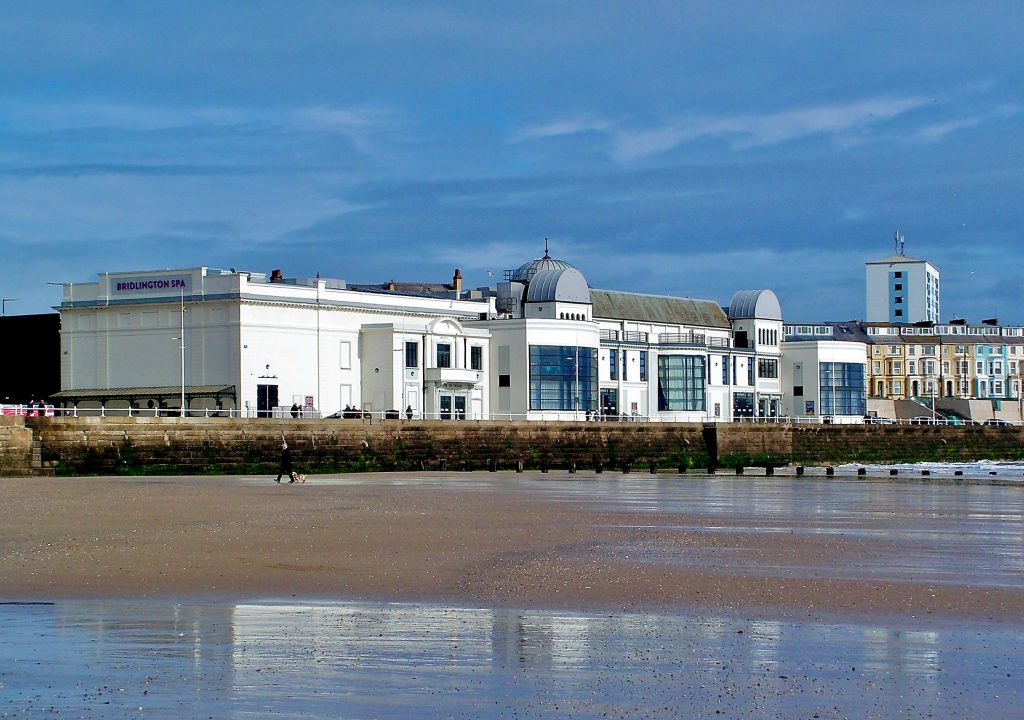
Bridlington is a seaside town and civil parish in the East Riding of Yorkshire, England. It is on the Holderness part (Flamborough Head to the Humber estuary) of the Yorkshire Coast by the North Sea. The town is about 28 miles (45 km) north of Hull and 34 miles (55 km) east of York. The stream called Gypsey Race flows through the town and enters the North Sea at the harbour.
The Priory Church of St Mary and the associated Bayle (or gate) are Grade I listed buildings on the site of an Augustinian Priory. As a sea-fishing port, the town is known for shellfish, and is the largest lobster port in Europe, with over 300 tonnes of the crustaceans landed there each year. It has been termed the “Lobster Capital of Europe”. Alongside manufacturing, retail and service firms, its main trade is summer tourism. It holds one of the UK’s coastal weather stations.
Ancient history
Archaeological evidence shows habitation of the area around the Bronze Age and Roman Britain era. The date of earliest habitation at Bridlington is unknown, but the 2.5-mile (4 km) man-made Danes Dyke at nearby Flamborough Head goes back to the Bronze Age.
A Roman road from York, now Woldgate, can be traced across the Yorkshire Wolds into the town. Roman coins have been found: two hoards in the harbour area, along with two Greek coins from the second century BC — suggesting the port was in use long before the Roman conquest of Britain.
In the fourth century AD, Count Theodosius set up signal stations on the North Yorkshire coast to warn of Saxon raids. It has been suggested that the current town was built near the site of a Roman maritime station called Gabrantovicorum. In the early second-century, Ptolemy described what was possibly Bridlington Bay in his Geography as Γαβραντουικων Ευλίμενος κόλπος: “Gabrantwikone bay suitable for a harbour”. No sheltered ancient harbour has been found, coastal erosion will have destroyed traces of any Roman installation near Bridlington Harbour.
Another position at Flamborough Head is also believed to have been a signal station – probably on Beacon Hill (now a gravel quarry) from where Filey, Scarborough Castle and the Whitby promontory can be seen. Another suggestion has been a line of signal stations stretching south round Bridlington Bay. A fort at Bridlington would have made a centre of operations for these. This counterpart to the northern chain would have guarded a huge accessible anchorage from barbarian piracy.
Discover more from WILLIAMS WRITINGS.
Subscribe to get the latest posts sent to your email.




Ooh, that’s a fancy beach building! All we have at our nearby beach is a public bathroom and a pier that used to have a restaurant at the end before it burned down.
yeah there is lots of space at our beaches James..