




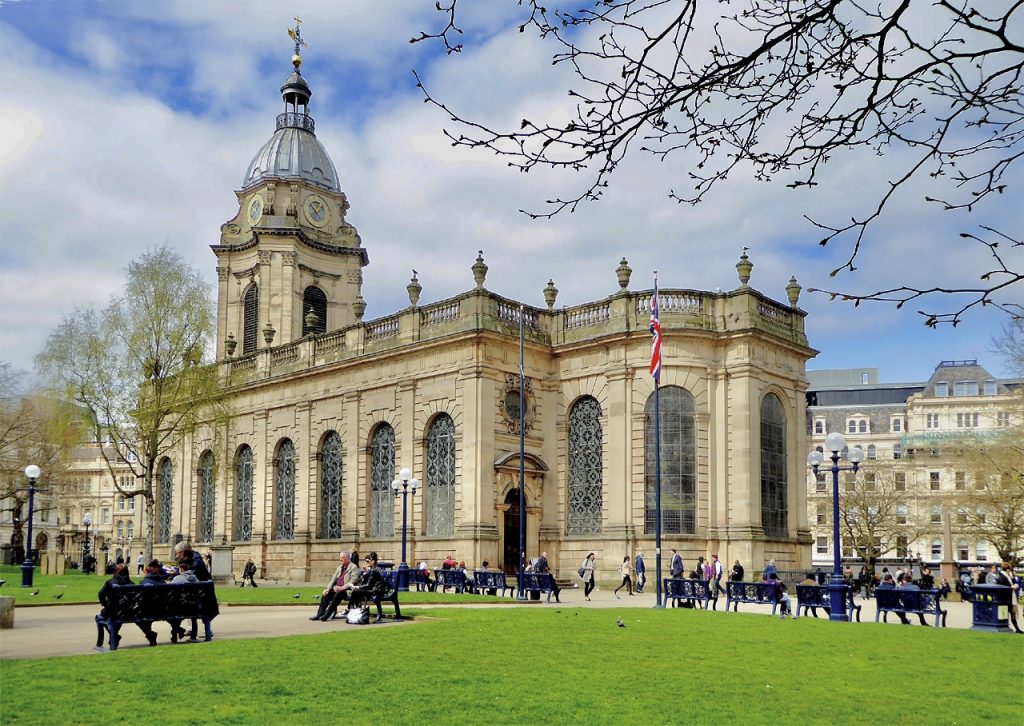
Birmingham is a city and metropolitan borough in the metropolitan county of West Midlands, within the wider West Midlands region, in England. It is the largest local authority district in England by population and the second-largest city in Britain – commonly referred to as the second city of the United Kingdom with a population of 1.2 million people in the city proper in 2024. Birmingham borders the Black Country to its west and, together with the city of Wolverhampton and towns including Dudley and Solihull, forms the West Midlands conurbation. The royal town of Sutton Coldfield is incorporated within the city limits to the northeast. Birmingham’s urban area has a population of 2.7 million and its wider metropolitan area has a population of 4.3 million.
Located in the West Midlands region of England, Birmingham is considered to be the social, cultural, financial and commercial centre of the Midlands. It is just west of the traditional centre point of England at Meriden, and is the most inland major city in the country, lying north of the Cotswolds and east of the Shropshire Hills. Distinctively, Birmingham only has small rivers flowing through it, mainly the River Tame and its tributaries River Rea and River Cole – one of the closest main rivers is the Severn, approximately 20 miles (32 km) west of the city centre. The city does however have numerous canals, collectively named the Birmingham Canal Navigations.
Historically a market town in Warwickshire in the medieval period, Birmingham grew during the 18th century during the Midlands Enlightenment and during the Industrial Revolution, which saw advances in science, technology and economic development, producing a series of innovations that laid many of the foundations of modern industrial society. By 1791, it was being hailed as “the first manufacturing town in the world”. Birmingham’s distinctive economic profile, with thousands of small workshops practising a wide variety of specialised and highly skilled trades, encouraged exceptional levels of creativity and innovation; this provided an economic base for prosperity that was to last into the final quarter of the 20th century.
The resulting high level of social mobility also fostered a culture of political radicalism which, under leaders from Thomas Attwood to Joseph Chamberlain, was to give it a political influence unparalleled in Britain outside London and a pivotal role in the development of British democracy. From the summer of 1940 to the spring of 1943, Birmingham was bombed heavily by the German Luftwaffe in what is known as the Birmingham Blitz. The damage done to the city’s infrastructure, in addition to a deliberate policy of demolition and new building by planners, led to extensive urban regeneration in subsequent decades.
Please share me.

Discover more from WILLIAMS WRITINGS.
Subscribe to get the latest posts sent to your email.



Birmingham is my home town, and has many interesting historical places to visit.
I read your article and mention of World War 2 bombing and it reminded me of my mum, who survived the many nights of bombing from the Hitler’s Germany during the Second World War. In one particular day she survived having her house hit by a bomb and wondered around dazzed due to shock. A neighbour took pity on her and brought out a chair for my mum to sit on. The neighbour then went back into her house make my mum a cup of tea. and then another bomb fell and destroyed that house and the kind neighbour. My mum remained buried under the rumble for hours until the ARP wardens dug her out. It took several days before she would step inside another building.
Best Wishes
Kevin
wow mate, fascinating your mum sounded a very brave lady, may she rest in peace.