






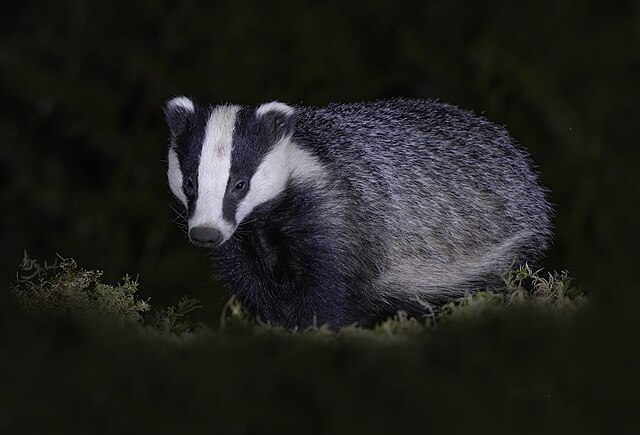
Badgers live in large family groups in a burrow system known as a sett. An occupied sett can be recognised by the tidy burrow entrances, large spoil heaps and may be marked with piles of used bedding (hay and leaves). Also look nearby for latrine pits where they leave their droppings. Cubs are born in January or February but spend the first two or three months underground, only emerging in the spring. The best time to spot badgers is during spring and summer, when the young cubs venture out of the den before nightfall.
Badgers use their amazing sense of smell to feed on earthworms, small mammals, birds eggs, fruit and roots and bulbs. Their strong front paws are well-suited to digging out burrows. If food is in short supply, badgers will forage during the day as well as at night.
Size
- Length: up to 1.2m including tail
- Weight: 7-17kg
- Average lifespan: 3 years but can live up to 14 years in the wild
Status
Fully protected in the UK by the Protection of Badgers Act, 1992, and the Wildlife and Countryside Act, 1981.
Distribution
Found throughout England, Wales, most of Scotland except for the far north, and Northern Ireland. Absent from Scottish Islands, the Isle of Man, the Isles of Scilly and the Channel Islands.
When to see
January – December
Facts
- Badgers can eat several hundred earthworms a night! They have a sense of smell 700-800 times better than ours to help them forage.
- Badgers provide a service to us. Whilst making their setts and foraging their digging stimulates regeneration and increased soil health as well as diversifying insects, trees, fungi and plant life around these sites. They even carry seeds on their fur and distribute them in their poo.
Please share me.

Discover more from WILLIAMS WRITINGS.
Subscribe to get the latest posts sent to your email.