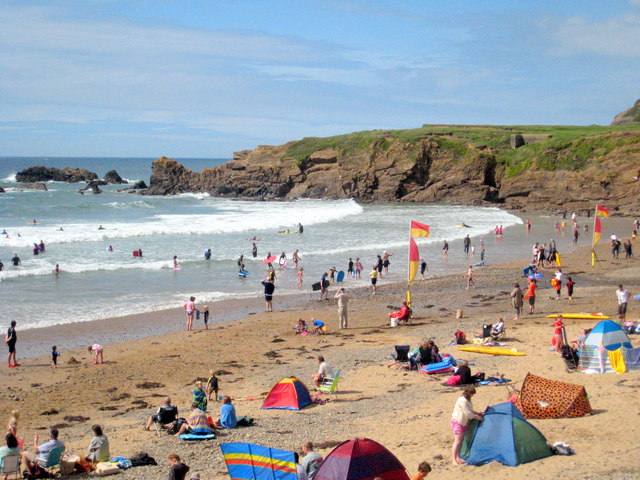
Bude is a seaside town in north Cornwall, England, in the civil parish of Bude-Stratton and at the mouth of the River Neet (also known locally as the River Strat). It was sometimes formerly known as Bude Haven.
It lies southwest of Stratton, south of Flexbury and Poughill, and north of Widemouth Bay, located along the A3073 road off the A39. Bude is twinned with Ergué-Gabéric in Brittany, France.[6] Bude’s coast faces Bude Bay in the Celtic Sea, part of the Atlantic Ocean. At the 2021 census, the built-up area as defined by the Office of National Statistics had a population of 7,350.
Its earlier importance was as a harbour, and then a source of sea sand useful for improving the inland soil. This was transported on the Bude Canal. The Victorians favoured it as a seaside resort. With new rail links, it became a popular seaside destination in the 20th century. Bradshaw’s Guide of 1866, Section 2, described Bude as “a small port and picturesque village in the north-eastern extremity of Cornwall”. It described the town as having the dignity of a fashionable marine resort with excellent facilities for bathers. The harbour bed consists of fine bright yellow sand consisting of small shells. “The sea view is of a striking, bold and sublime description – the rocks rising on every side to lofty broken elevations.” It also describes Bude as a romantic retreat.
Geography
Townscape.
Bude lies just west of Stratton and north of Widemouth Bay and is located along the A3073 road off the A39 road. The section of the A39 running through Bude is known as the Atlantic Highway.
Coastline.
A section of Bude’s coast, between Compass Cove to the south and Furzey Cove to the north, is a SSSI (Site of Special Scientific Interest) noted for its geological and biological interest. Part of the land designated as the Bude Coast Site of Special Scientific Interest is owned by the National Trust. Carboniferous sandstone cliffs surround Bude. During the Variscan Orogeny the strata were heavily faulted and folded. As the sands and cliffs around Bude contain calcium carbonate (a natural fertiliser), farmers used to take sand from the beach, for spreading on their fields. The cliffs around Bude are the only ones in Cornwall that are made of Carboniferous sandstone, as most of the Cornish coast is formed of Devonian slate, granite and Precambrian metamorphic rocks.[9] The stratified cliffs of Bude give their name to a sequence of rocks called the Bude Formation. Many formations can be viewed from the South West Coast Path which passes through the town.
Many ships have been wrecked on the jagged reefs which fringe the base of the cliffs. The figurehead of one of these, the Bencoolen, a barque whose wrecking in 1862 resulted in the drowning of most of the crew, was preserved in the churchyard but was transferred to the town museum to save it from further decay. The aftermath of the wreck of the Bencoolen was described by Robert Stephen Hawker in letters which were published in Hawker’s Poetical Works (1879).
Discover more from WILLIAMS WRITINGS.
Subscribe to get the latest posts sent to your email.